
REPRODUCTIVE HEALTH TALK-FEMALE HEAD PORTERS

On the 8th of May, The day for celebrating Mothers’ Day in Ghana,
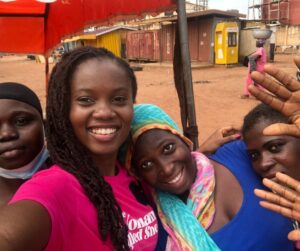
The Woman Called She (TWCS) organised a reproductive health talk for Female Head Porters (Kayayee) at the Madina New Market. There are hundreds of female head porters at the Madina New Market, these women live on the Market grounds. These girls come from the northern parts of Ghana to engage in economic activities down south. A lot of them are teenagers, and there are some who are below the teen years.
Their ‘homes’ are made of temporary structures, where they retire to sleep after a hectic day carrying items for people. Their living conditions are quite appalling and some of these girls/women live with their children, some babies and toddlers. From their earnings, some of them remit their families.
The worrying trend with these girls is that many of them have children, it is common to see girls barely out of their teen years with children and disheartening to see those younger than them already pregnant. These children do not go to school, but rather loiter around at the mercy of all social vices.
TWCS decided to do sensitization among these group of people in order to give them the knowledge they need to take charge of their reproductive health. For almost a month to the day of the Talk, our field staff went around weekly to sensitize them about the upcoming talk and what they were to expect. The initial reaction was that of wariness and outright rejection; most of them were not interested and the rumour that was being spread around was that they were going to be injected.
It was alarming to note that most of these girls were illiterates, some have not been to school at all. They had heard of family planning but had not bought into the benefits that could give them. Many were downright dis-interested in whatever the talk was about. We however got a number who put down their names to be part of the talk.
DAY OF THE TALK

On the day of the talk, even those who had put down their names were not willing to take a seat. We had to go around again, to their shacks to encourage them to come out and listen. It was as if they were feeling shy to be seen listening to a family planning talk. I encountered a girl, who told me she was nineteen years old, she had two little children by her, she told me they were hers. I eagerly suggested that she join us for the talk and she firmly shook her head in the negative. I asked her why and she only gave me half a smile and went about her washing.
Shack after shack, they told us to go they will come but showed no signs of getting up to join us. Finally, about fifty women joined us to listen to the talk on the various types of family planning methods and an education on Cervical cancer.
CYNTHIA
On their visits to their sleeping area, weeks before the talk, the field staff encountered Cynthia a 25-year-old woman who lived with the Kayayee. From their interactions they realised she was more educated; an SSS graduate and as such quite different from the others. She helped to spread the information on the incoming talk.
The reason why she is of importance is that she is 25 years and did not have a child yet. What made her different was the education that she had received, buttressing the point that education is the most important tool in the fight to elevate these girls from their current state. During the talk, she was able to translate most of what was discussed to their local dialect for better assimilation.
According to her, she was not in a rush to marry and have children just yet and was more interested in saving enough money to further her education.
It is interesting to note that a lot of the girls came out to the grounds when food, drinks were being shared and the music started playing.
SOLUTION TO THE KAYAYEE PROBLEM
The Kayayee are hardworking girls who earn a living from what they do. As stated earlier, some of them send monies home for their whole family’s upkeep. If we want to empower these women, it will take a cultural and social intervention. The issue is with their socialisation and their belief that having more children is a sort of achievement.
To help these girls, their chiefs and opinion leaders in the various towns they come from have a lot to do. Religion and culture seem to have quite an influence on these girls and if the sensitization is not done from their society it will take quite some time to get them have a mind shift or to see that there is a better way to live.